
Subscribe to Pewsitter

Hungarian Ambassador To The Vatican Claims 'Pope's statements on immigration problems becoming more nuanced'
August 31, 2016
Hungarian Ambassador To The Vatican Claims 'Pope's statements on immigration problems becoming more nuanced'
MUNICH, ROME – The Hungarian ambassador to the Vatican, Eduard von Habsburg, reported that the Pope grasps the difficulties of the migration crisis in an August 30th with the German Catholic Tagespost. The Pope, he says, has recently made “statements in which one can sense that the reality of many countries, influenced by the enormous stream of migrants and refugees, has reached him a little bit more.” His comment comes just after the Pope received Hungarian Prime Minister Viktor Orbán Orbán as a member of an international delegation of Catholic lawmakers.
Viktor Orbán is well-known for his opposition to immigration from the Middle East into Europe. In a given in Budapest on March 15th of this year, Orbán declared that the movement of large numbers of Muslim refugees into Europe was a deliberate policy of Brussels, the seat of the EU, to “reshape the religious and cultural landscape of Europe, and to re-engineer its ethnic foundations.” Orbán further stated Hungary’s intention to preserve its cultural and religious independence, and forbade the settlement of any refugees within Hungary’s borders. Few other European leaders have made such strong public statements against Middle Eastern immigration.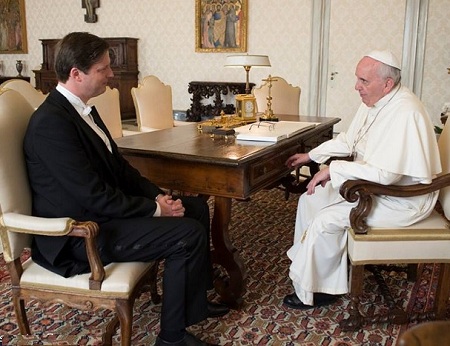
Ambassador von Habsburg, asked about the discrepancy between Orbán’s anti-immigrant views and Pope Francis’ record of pro-immigration statements, replied that Francis was moving between two poles: “as an evangelizer preaching the need to see Christ in every man, and on the other hand, as the head of 1.2 billion Catholics, keeping the worldwide political reality in view.” He cited Francis’ statements to the New Year’s meeting of diplomats, namely that countries have a duty both to take in refugees and also to secure their borders and give their citizens a sense of safety.
“In the Holy See,” von Habsburg continued, “there is some sympathy for the concrete problems of Hungary, arising from its size and geographical location.” von Habsburg refers to criticism of Hungary and Orbán from the international community regarding the decision to build fences on the eastern border with Serbia and Romania. Hungary is an outlying member of the Schengen Area, which abolishes internal borders across most of Europe; as such it has the obligation to screen applicants for admission on behalf of all Schengen Area countries, as Habsburg explained in his interview. “If you do not protect the Schengen Area at its external borders, the whole system breaks together,” von Habsburg explained, and said that the Holy See recognizes Hungary’s obligations to the European community.
Pope Francis has a consistent record of encouraging European and Western countries to welcome the vast numbers of people fleeing the Middle East, which he explains in terms of the Church’s pastoral mission. His recognition of the political and social difficulties that countries face in doing so has not been clear in the past. However, von Habsburg claims that the Vatican’s official views on refugee policy have become “more nuanced in the course of recent months.” Ambassador von Habsburg spoke of the warm relations between Hungary, a politically Christian country, and the Vatican, and defended the Pope’s need for diplomacy toward Islam: “The Pope wants to show them that he responds to them at eye level and welcomes an alliance. What else should the world’s most respected religious representative do?”
In the wake of von Habsburg’s remarks, the Vatican that Pope Francis, continuing the bureaucratic reform that has been a hallmark of his papacy, has merged four Vatican offices into the “Dicastery for the Service of Integral Human Development”, beginning Jan. 1st. The Pope himself will oversee the work of this office. In the Motu Proprio announcing the change, Pope Francis wrote that the Dicastery will oversee the Church’s international humanitarian efforts, focusing on "migrants, those in need, the sick, the excluded and marginalized, the imprisoned and the unemployed, as well as victims of armed conflict, natural disasters, and all forms of slavery and torture”. Pope Francis says that he will temporarily take personal charge of migration because "there cannot be a service for integral human development without paying particular attention to the phenomenon of migration."
Ambassador von Habsburg is a direct descendant of Emperor Franz Josef the First, of the Austro-Hungarian Empire. He alluded to this historical consciousness in the interview, mentioning that immigration brings back uneasy memories of the Turkish Ottoman Empire for many Hungarians.

